Walled gardens · Malá Strana
The Wallenstein Garden, a general's garden behind high walls
Below Prague Castle, a commander of the Thirty Years' War built himself a palace and an Italian garden behind high walls. The garden is still there, and it is open for half the year.
Malá Strana is a district of high walls, and behind most of them lies a garden. The largest and grandest of these is the Valdštejnská zahrada, the Wallenstein Garden, laid out in the 1620s for the palace of Albrecht of Wallenstein, Albrecht z Valdštejna. From the street it is a long, blank wall on Letenská. Through the gate it is a formal garden of gravel walks, clipped hedges and bronze statues, with a huge open loggia at one end and the spires of Prague Castle rising above the roofs.
A garden built for a general
Wallenstein was a Bohemian nobleman who rose fast in the Thirty Years' War. After the Battle of White Mountain in 1620, when the Protestant Bohemian estates were defeated, he bought up large amounts of land confiscated from the losing side, and he became one of the richest men in Central Europe and the commander of the emperor's armies.
He wanted a palace in Prague to match. Between 1623 and about 1630, more than twenty houses, several gardens and a brickworks were cleared below the castle to make room for it. The result was the first great Baroque palace in Prague, built around courtyards, with a riding school and a garden enclosed by walls on all sides.
The scale was a statement. The palace stood directly below the castle, the seat of royal power in Bohemia, and it was built to rival it. The wall around the garden carried the same message: inside lay a private world laid out by architects and artists brought from Italy; outside were the crowded streets of the Lesser Town.
Wallenstein had little time to enjoy it. He grew too powerful for the emperor's comfort, and in 1634 he was killed at Cheb, in western Bohemia, by officers acting on the emperor's behalf. The palace passed to his relatives and stayed in the family's hands for centuries. Today it is the seat of the Senate of the Czech Republic, and the garden is open to the public in the warmer months.
The sala terrena and the long axis
The garden is built along a main axis that runs from the palace to the far wall. At the palace end stands the sala terrena, a huge open loggia of three tall arches, its vault and walls covered in stucco and paintings of scenes from classical myth. It was designed for summer entertainment, a room open to the air where the garden became part of the house.
The sala terrena is the largest structure of its kind in Prague, and its size is the first thing you notice. Stand at the far end of the axis and look back: the arches fill the view, framed by the clipped hedges, and the palace roofs rise behind them. Concerts and theatre are sometimes held there in summer, with the audience sitting on the gravel. From several points in the garden, the spires of St Vitus Cathedral rise over the roofs, a reminder of how close to the castle Wallenstein chose to build.
Along the axis stand bronze statues of gods and heroes. The originals were made by Adriaen de Vries, one of the finest sculptors of the age, but they did not stay long. In 1648, at the end of the Thirty Years' War, Swedish troops took them as war booty, and most of them are still in Sweden. The figures you see in the garden today are copies, cast to stand in the places of the originals.
The figures you see in the garden today are copies, cast to stand in the places of the originals.A4Petřín, orchards and paths up the hill
The dripstone wall
Along one side of the garden runs the strangest feature in Malá Strana: a long, high wall made to look like the inside of a cave. Its surface is built up into knots, drips and hanging shapes like stalactites, grey and porous, with holes and hollows across its whole length. It was meant as a grotto, a fashionable piece of garden theatre in the seventeenth century, and it still looks unlike anything else in the city. Its texture changes with the light through the day, and in the late afternoon its hollows fill with shadow.
Look at it closely and you start to see faces, animals and snakes in the shapes. Whether they were made on purpose or are simply what the eye finds in a rough surface is part of the game. At one end is an aviary, and in the garden you will usually find an owl or two in their cage near the wall.
The pond, the peacocks and the riding school
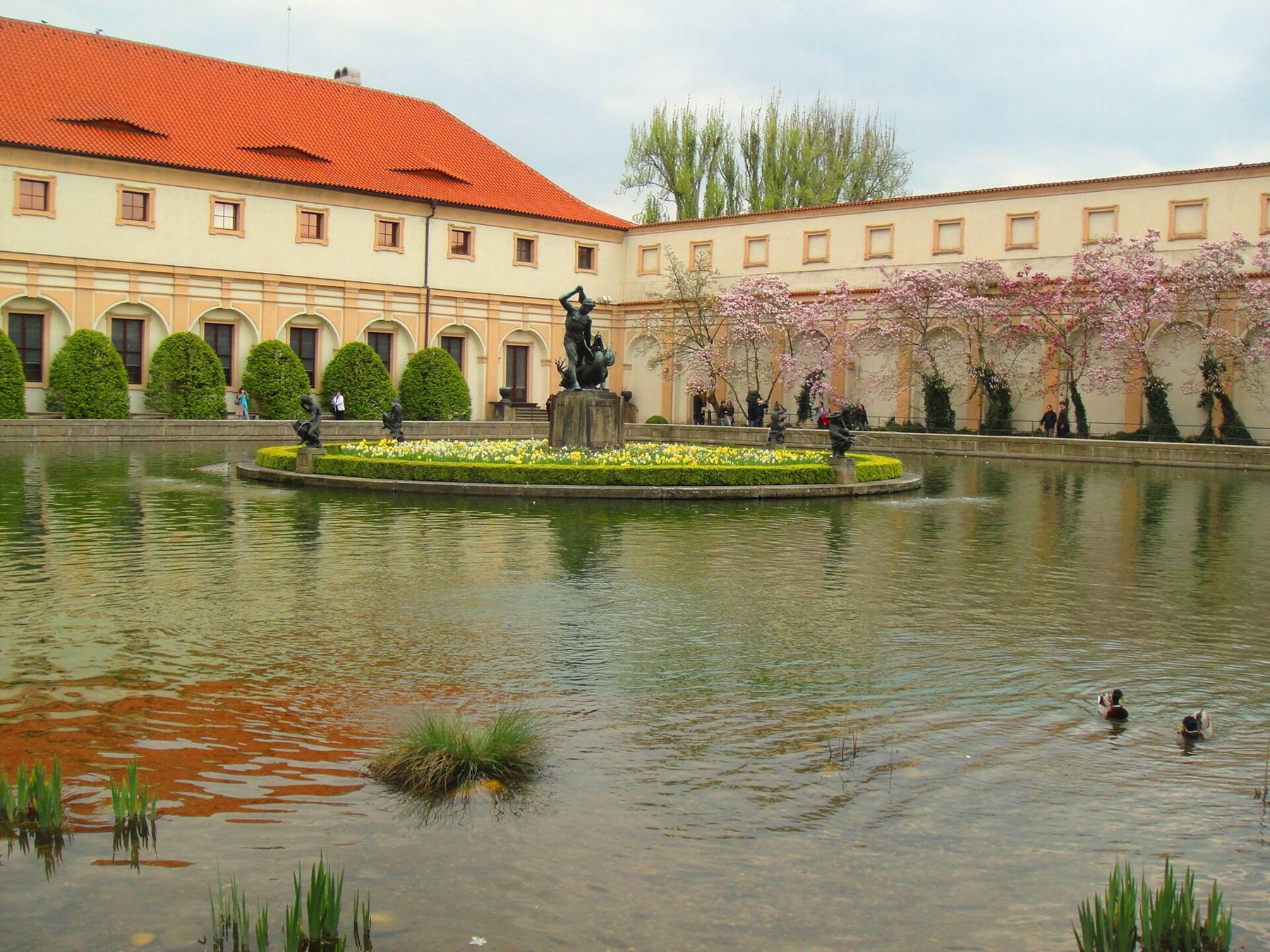
At the eastern end of the garden is a large rectangular pond with an island in the middle, on which stands a bronze of Hercules fighting a monster. Ducks drift across the water, and in spring the magnolias along the wall behind it come into flower. The pond is the quietest corner of the garden, with the long wing of the palace complex rising behind it.
Peacocks walk freely around the garden, on the gravel, on the lawns and sometimes on the walls. There is usually at least one white peacock among them. They are used to people, but they are not tame, and they do not want to be fed or chased.
Close to the eastern end of the garden stands the Valdštejnská jízdárna, the palace's riding school, now used by the National Gallery for exhibitions. It has its own entrance near Malostranská metro, and its programme changes through the year.
The palace and the Senate
The palace itself is the seat of the Senate, the upper house of the Czech parliament. Its main halls, including a grand hall with a painted ceiling showing Wallenstein as Mars, are opened to visitors on set days, usually at weekends; the rest of the time the building is at work. In the garden you may see senators and staff crossing between buildings.
The palace's front faces Valdštejnské náměstí, a small square that climbs towards the castle. From there, Vojanovy sady is a short walk east, and the steep lanes lead up to the castle or down towards the river.
Coming and going
The most convenient entrance is on Letenská, near Malostranská metro, where a gate in the wall opens straight into the garden. The other is from Valdštejnské náměstí, through the palace courtyards. Entry to the garden is generally free, but it is open only from spring to autumn, and it closes in the early evening. Inside, keep to the gravel walks: the lawns and clipped hedges are for looking at, and benches along the edges are there for sitting. In the palace, which is a working parliament, follow the instructions of the staff, and expect that there may be a security check at the door.
From the Letenská gate, the riverbank at Klárov is a few minutes away; from there, the steps of the old castle stairs climb to Hradčany. Walk the other way, along Letenská and across the river by the Mánes Bridge, and you reach the Old Town near Josefov. Or climb from Klárov to the plateau of Letná, where the park looks back across the river towards the garden you have just left.
Come early in the season, when the magnolias are in flower and the gravel is fresh, or late in the afternoon on a summer day, when the sun lights the arches of the sala terrena. On a weekday, with few visitors, you can sit by the pond and hear nothing but water and the peacocks.
The photographs on this page were shared under open licences; their makers are listed on whose photos.
A3Next square: Vojanovy sady