Off the grid · Vinohrady
Vinohrady, tree-lined streets and a view to the castle
Above the New Town, a district of apartment blocks, squares and parks grew out of the royal vineyards. Its streets are calm, its trams are frequent and its western slope looks straight at the castle.
Climb past the National Museum at the top of Wenceslas Square and the city changes. The grand fronts of the New Town give way to long, straight streets of apartment blocks, with trees along the pavements, small squares at the crossings and parks on the slopes. This is Vinohrady, one of the most pleasant districts in Prague to walk, and one where people simply live. There are no great sights here, only good buildings, green space, and views back across the city.
From royal vineyards to apartment blocks
The name means vineyards. Charles IV had vines planted on the slopes above the New Town in the fourteenth century, and for a long time the area was farmland, vineyards and orchards outside the city walls, known as the Royal Vineyards, Královské Vinohrady.
In the second half of the nineteenth century, as the walls came down and Prague grew, the vineyards were built over. Vinohrady became a town of its own, granted town rights in 1879, and it grew fast as a place for the new middle classes, with wide streets, apartment blocks with ornamented fronts, schools, churches and a large theatre. In 1922 it was joined to Greater Prague, along with many of the surrounding towns.
The result is a district built in a few decades and in a few styles: neo-Renaissance, art nouveau, and the plainer modern blocks of the interwar years. Walk along any street and look up: balconies, carved heads, painted panels and corner turrets show how much the builders cared about the fronts. Read the street names as you go: a few recall foreign places, such as Londýnská, Americká and Francouzská.
Náměstí Míru and St Ludmila
The centre of Vinohrady is Náměstí Míru, Peace Square, a few minutes on foot from the top of Wenceslas Square. It is a large, green square with trees, lawns and benches, and at its heart stands the neo-Gothic Church of St Ludmila, built in the 1880s and 1890s to designs by Josef Mocker, with two tall spires that can be seen from far away.
On the edge of the square stands the Vinohrady Theatre, Divadlo na Vinohradech, opened in 1907, with an art nouveau front topped by sculpted figures. Below the square runs the metro: Náměstí Míru station on line A is one of the deepest in the network, and its long escalators are an experience in themselves. Trams cross the square too, so it is the easiest place to start. The square in front of St Ludmila is the meeting point of the district, and in December it fills with market stalls.
Havlíčkovy sady and the vineyard
From Náměstí Míru, walk south-east for about fifteen minutes to Havlíčkovy sady, also known as Grébovka. This park was laid out in the 1870s and 1880s around the villa of the industrialist Moritz Gröbe, on a slope looking south over the valley of Nusle. It is one of the most varied parks in Prague, with woods, lawns, an artificial grotto, a fountain, a wooden pavilion and, on the southern slope, a vineyard.
The vineyard is a reminder of where the district got its name. Vines grow on terraces down the slope, and the park's pavilion sits above them with a view across the valley. It is a quiet place to sit, and on a summer evening the slope catches the last of the sun. The villa itself, built in the manner of an Italian Renaissance house, stands at the top of the park; the grounds are the reason to come.
→Karlín, the grid that came back after the floodThe streets in between
From Havlíčkovy sady, walk back north through the side streets. The blocks between Náměstí Míru and the next big square are some of the most attractive in the district: long rows of apartment houses, each with its own decoration, trees along the pavements, and small corner shops and workshops at street level. Few visitors come here, and the streets feel like a neighbourhood rather than a sight. Notice how the corner buildings are treated: many have turrets, rounded bays or small domes, designed to be seen down two streets at once.
The main street to the north is Vinohradská, a wide avenue with trams that runs east from the National Museum. Follow it to Náměstí Jiřího z Poděbrad, a square with a modern landmark: the Church of the Most Sacred Heart of Our Lord, designed by the Slovenian architect Jože Plečnik and built from 1928 to 1932. Its huge, flat clock tower with a round glass clock face and its walls of dark brick dotted with granite blocks are unlike any other church in the city. Plečnik also worked on Prague Castle for President Masaryk, and his hand can be seen in both places.
Riegrovy sady in the evening
From Náměstí Jiřího z Poděbrad, walk west to Riegrovy sady. This park, laid out in the early twentieth century and named after the politician František Ladislav Rieger, sits on the western edge of Vinohrady, where the ground drops steeply towards the main railway station and the New Town.
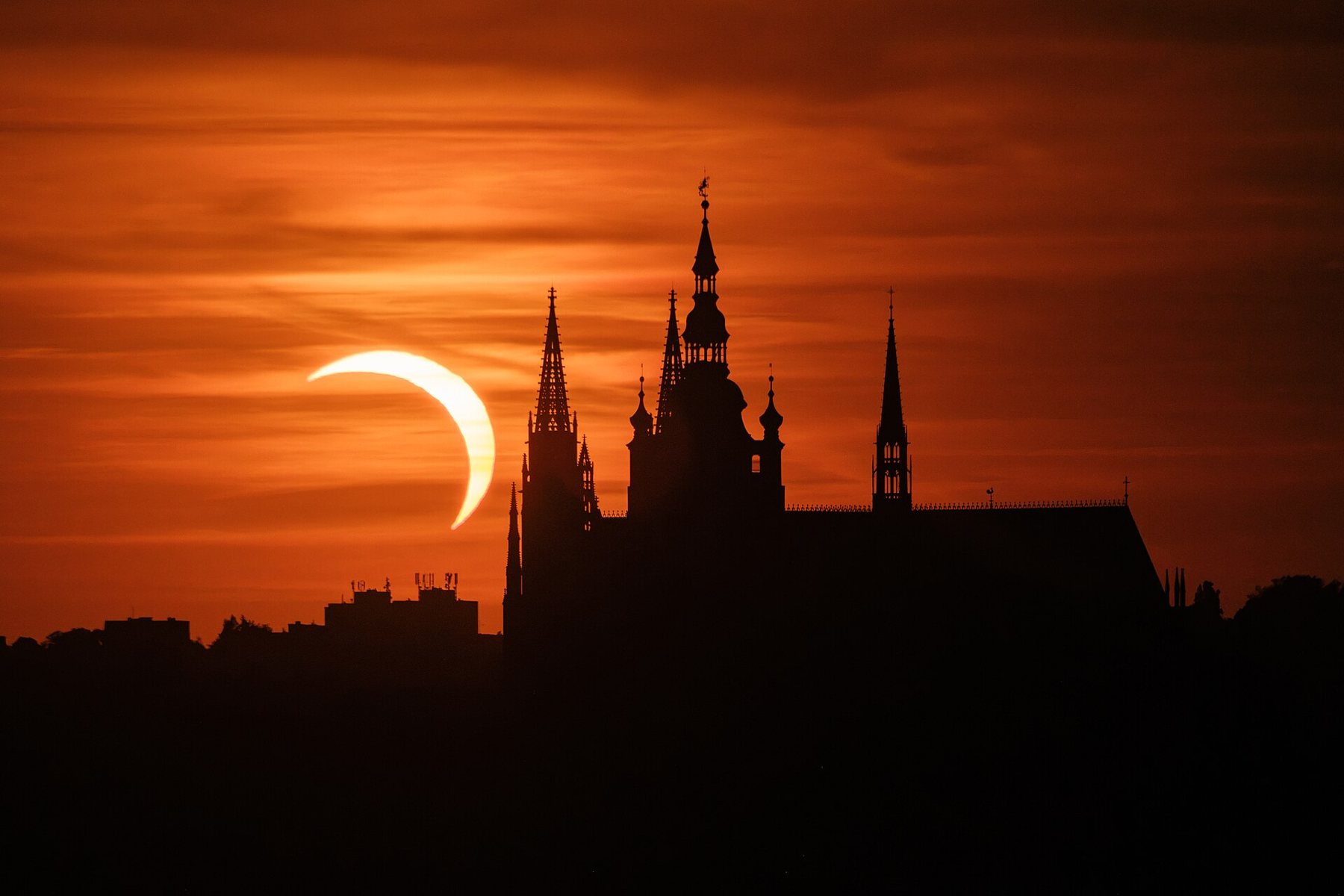
The upper part of the park is a long, open lawn that slopes down to the west. From the top, the whole of central Prague spreads out below, and in the distance, on its ridge, stands Prague Castle with the spires of St Vitus Cathedral. Because the view looks west, this is the place to watch the sun go down behind the castle.
Because the view looks west, this is the place to watch the sun go down behind the castle.
On a summer evening, the slope fills with people sitting on the grass, talking, reading and waiting for the sunset. The photograph at the top of this page was taken from the park on the evening of 12 August 2026, when a partial solar eclipse coincided with sunset: the cathedral stands in silhouette against an orange sky, with the narrow crescent of the eclipsed sun beside its spires. On an ordinary evening the view is calmer, but the line of the castle against the light is the same.
A small terrace and paths lead down through the trees, and the park is also popular with dog walkers and families during the day. In winter, when the slope is covered in snow, it is used for sledging. Bring a jacket even in summer; once the sun drops behind the castle, the slope cools quickly.
Trams and coming back
Vinohrady is well served by trams and metro. Line A runs under the district, with stations at Náměstí Míru and Jiřího z Poděbrad, and several tram lines cross it, linking it with the New Town, the main station and the districts further east. The trams are worth riding for their own sake: from a window seat you see more of the district's fronts in ten minutes than on a long walk. From Riegrovy sady, you can walk down to the main railway station in ten minutes, or take a tram back to the centre.
A good walk takes half a day: Náměstí Míru, Havlíčkovy sady, the side streets, Náměstí Jiřího z Poděbrad and, at the end of the day, Riegrovy sady for the sunset. If you have more time, walk east to the large cemetery at Olšany, or north down the hill to Karlín, the district at the foot of the next hill. For contrast, finish the day in the passages of the New Town, such as the Lucerna passage, a short tram ride away.
The photographs on this page were shared under open licences; their makers are listed on whose photos.
→Next square: Karlín