Walled gardens · Malá Strana
Vojanovy sady, the quiet orchard behind the wall
Between Charles Bridge and the Wallenstein Palace, a plain door in a high wall leads into one of Prague's oldest gardens: fruit trees, lawns, benches, peacocks and a grotto chapel.
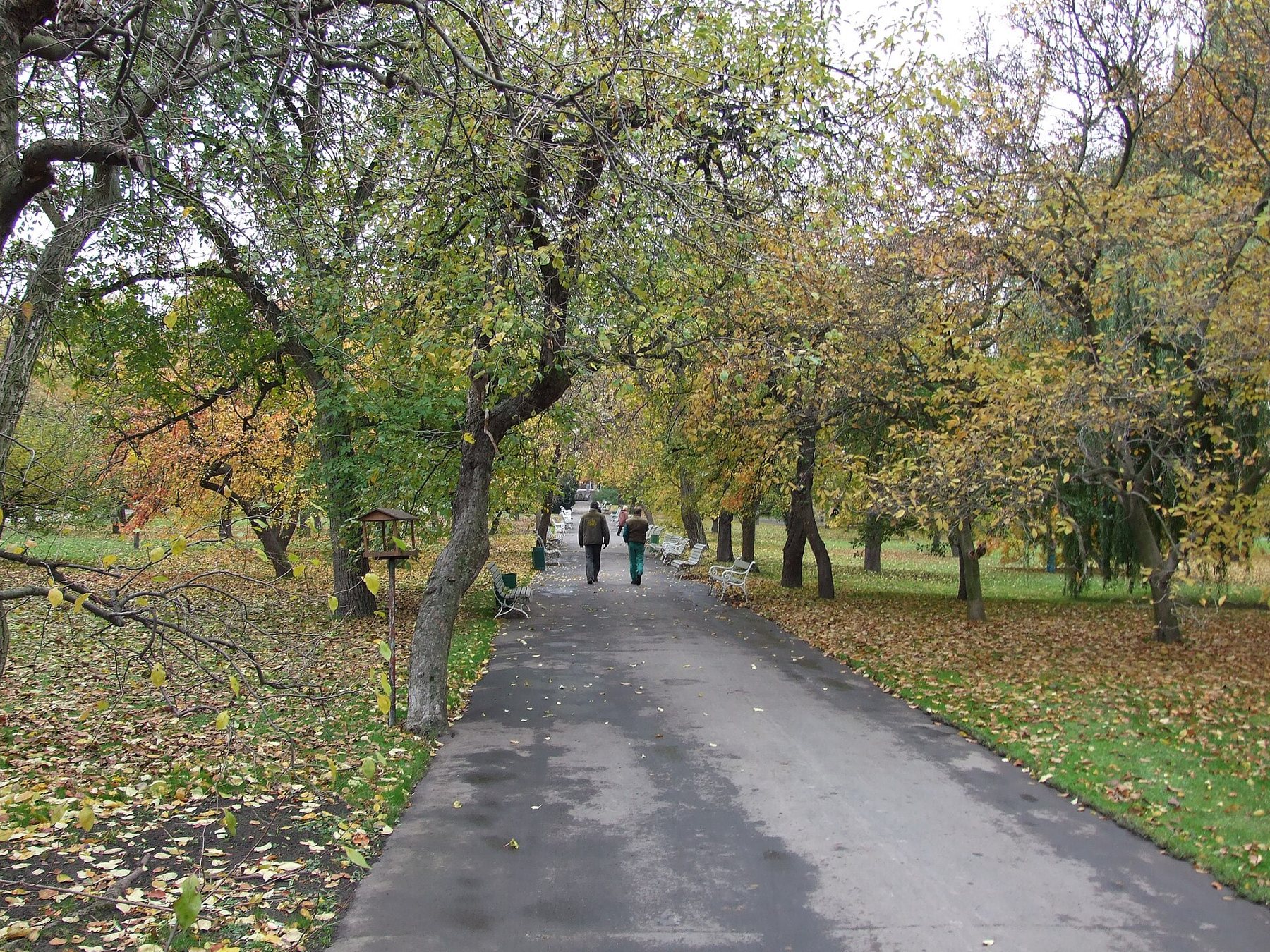
A few minutes from the crowds of Charles Bridge, the street called U Lužického semináře runs north through Malá Strana between high walls. On one side, a plain door opens into Vojanovy sady, a garden of fruit trees, lawns and gravel paths, enclosed on every side. It is one of the oldest gardens in Prague and, for its position, one of the quietest. There is no grand palace here and no view of the castle, just trees, benches and the sound of birds.
A door in the wall
The entrance is easy to miss. Walk from the Malá Strana end of Charles Bridge along U Lužického semináře towards Klárov and look for the gate in the long garden wall. There is a small sign. Once inside, the garden opens out in front of you, larger than you expect, with old trees in rows and paths running away under them.
The walls are the point. They shut out the traffic of the riverbank and the noise of the tourist streets, and they make the garden feel like a world of its own. From inside, you see only the tops of the surrounding buildings over the walls, and the upper floors of the old houses of Malá Strana.
Inside, the noise of the city drops at once. The paths are mostly level, the ground is shaded by the trees, and there are few buildings within the walls. It feels less like a city park than like the orchard of a country house that the town has slowly grown around.
An orchard with a long past
The ground has been a garden since the Middle Ages, when it belonged to the court of the bishops of Prague, which stood near the Malá Strana end of the old stone bridge across the Vltava. Later it passed to a convent of Carmelite nuns, whose church of St Joseph stands nearby, and it stayed an enclosed religious garden for a long time.
The garden was eventually opened to the public, and it took its present name from Eduard Vojan, one of the great Czech actors of the late nineteenth and early twentieth centuries. The name sady, orchards, describes what it still is: rows of fruit trees growing in grass, with paths between them.
Unlike the formal gardens below the castle, Vojanovy sady has never been trimmed into patterns. The trees lean and spread, the grass grows long in places, and the whole garden has the feel of an old orchard that has been looked after rather than designed.
Two chapels
The garden holds two small Baroque chapels, both from its years as a convent garden. The more unusual is the chapel of St Elijah, built to look like a grotto, with an outer surface of rough, stalactite-like forms, a reminder that the prophet Elijah was a patron of the Carmelites, who traced their order to his cave on Mount Carmel. The other is a chapel of St John of Nepomuk, the saint whose statue stands on Charles Bridge.
Neither is a great monument, and they are usually closed. They are best seen as part of the garden, small buildings set among the trees, adding to the sense that this was once a private, contemplative place. Look at the grotto chapel's rough surface: it echoes the dripstone wall of the nearby Wallenstein Garden and shows how much Baroque garden makers liked artificial caves.
A2The Wallenstein Garden, a general's garden behind high wallsPeacocks, benches and a pond
Like the much larger garden of the Wallenstein Palace nearby, Vojanovy sady has peacocks. They walk through the grass and along the paths, perch on the walls and branches, and call loudly from time to time. They are used to people, but they should not be fed or chased.
The rest of the garden is made for sitting. Benches line the main paths, and the lawns between the trees are left open. On a weekday morning, you may share the garden with a handful of people: residents walking dogs, parents with prams, someone reading on a bench. At weekends it is busier but rarely crowded.
In spring the fruit trees blossom, and the garden is at its best in April and early May. In autumn, as in the photograph at the top of this story, the leaves turn yellow and fall on the paths, and the light is low and soft. In summer the trees give shade, and the garden is cooler than the streets outside.
Around the garden
Vojanovy sady sits in a part of Malá Strana that is full of small things worth a look. To the south, U Lužického semináře leads back to Charles Bridge and the bridge towers, and beyond them to Kampa and the narrow channel of Čertovka. Kampa, the island between the main river and Čertovka, has a park of its own, with old trees, lawns and a view across the water to the Old Town. Together with Vojanovy sady and the gardens below the castle, it makes this corner of Malá Strana one of the greenest parts of the centre. To the north, the street comes out at Klárov, near Malostranská metro and the Letenská gate of the Wallenstein Garden.
From Klárov, a path climbs to the plateau of Letná, and the old castle steps lead up to Hradčany. Across the river, by way of Mánes Bridge, is the Old Town and Josefov and its synagogues.
A good loop starts at Charles Bridge, walks north along U Lužického semináře, spends half an hour in Vojanovy sady, then continues to the Wallenstein Garden and back through the lanes of Malá Strana. It is an easy hour, with very little traffic. The garden is also a good place to rest after crossing Charles Bridge, which is crowded for much of the day.
When to come
The garden is open every day, from morning until about dusk, with shorter hours in winter and longer in summer. The gate is locked at closing time, which is posted at the entrance; check before you go. Entry has generally been free. In wet weather the edges of the paths can be muddy, and in autumn the fallen leaves make them slippery.
Come in the morning or late afternoon, when the light falls through the trees. Keep your voice down, keep dogs and children away from the peacocks, and remember that the garden is valued most for its quiet. On the way out, look back through the gate before it closes behind you: the wall hides the whole orchard again within a step.
The photographs on this page were shared under open licences; their makers are listed on whose photos.
A4Next square: Petřín